Official rule text as published in the U.S. Coast Guard Navigation Rules
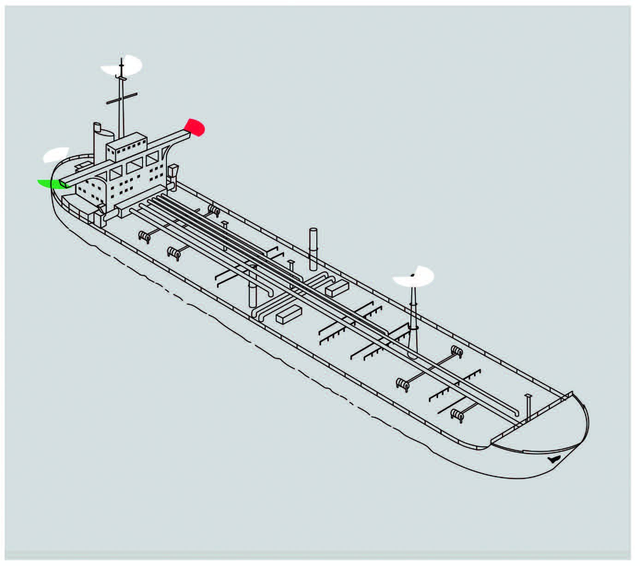
(a) A power-driven vessel underway shall exhibit: (i) a masthead light forward; (ii) a second masthead light abaft of and higher than the forward one; except that a vessel of less than 50 meters in length shall not be obliged to exhibit such a light but may do so; (iii) sidelights; and (iv) a sternlight.
(b) An air-cushion vessel when operating in non-displacement mode shall, in addition to the lights prescribed in Rule 23(a), exhibit an all-round flashing yellow light, where it can best be seen.
(c) A WIG craft only when taking off, landing and in flight near the surface shall, in addition to the lights prescribed in Rule 23(a), exhibit a high intensity all-round flashing red light.
(d)(i) A power-driven vessel of less than 12 meters in length may in lieu of the lights prescribed in Rule 23(a) exhibit an all-round white light and sidelights.
| International |
|---|
(ii) a power-driven vessel of less than 7 meters in length whose maximum speed does not exceed 7 knots may in lieu of the lights prescribed in Rule 23(a) exhibit an all-round white light and shall, if practicable, also exhibit sidelights.
(iii) the masthead light or all-round white light on a power-driven vessel of less than 12 meters in length may be displaced from the fore and aft centerline of the vessel if centerline fitting is not practicable, provided that the sidelights are combined in one lantern which shall be carried on the fore and aft centerline of the vessel or located as nearly as practicable in the same fore and aft line as the masthead light or the all-round white light. |
| Inland |
|---|
| (e) A power-driven vessel when operating on the Great Lakes may carry an all-round white light in lieu of the second masthead light and sternlight prescribed in Rule 23(a). The light shall be carried in the position of the second masthead light and be visible at the same minimum range. |
Color note: black text applies generally; blue is International Waters; green is Inland Waters.
MyCOLREGS explanation
Summary
A power-driven vessel underway shows a forward masthead light, sidelights, and a sternlight; a second, higher masthead light abaft the first is optional under 50 meters and required at 50 meters and up. Air-cushion vessels in non-displacement mode add an all-round flashing yellow light, and WIG craft taking off, landing, or flying near the surface add a high-intensity all-round flashing red light. Small power-driven vessels get simplified options: under 12 meters, an all-round white light plus sidelights may substitute for the full set internationally, under 7 meters and 7 knots or less, an all-round white light alone may suffice (sidelights if practicable), with some flexibility on exact placement. On the Great Lakes, a vessel may substitute one all-round white light for the second masthead light and sternlight, carried where the second masthead light would go.
Real World Example
The second masthead light isn't a redundant backup - watching how the aft light rises and separates from the forward one over time is how an experienced lookout judges a ship's aspect and closing rate at night without needing radar. Vessels under 50 meters can skip it because at that size and range the sidelights alone give enough warning; a full-sized ship needs the pair because losing that depth cue at long range would cost real reaction time.
Practice Questions
Q1. A 45-meter (about 148-foot) power-driven vessel underway at night is showing a forward masthead light, sidelights, and a sternlight, but no second masthead light. Is she in compliance with Rule 23(a)?
A. No - she is missing her towing light, which every power-driven vessel over 20 meters must display regardless of length.
B. No - every power-driven vessel must show two masthead lights regardless of her length, so the second light is never optional.
C. Yes - a vessel under 50 meters is not obliged to show the second, higher masthead light, though she may do so.
D. Yes, but only if she is also under sail, since a motor-sailing vessel is held to a lower lighting standard than one under power alone.
Q2. A 10-meter (about 33-foot) powerboat elects to show a single all-round white light plus sidelights instead of the full Rule 23(a) light suite. Under Rule 23(d)(i), is this permitted?
A. No, this option is limited to sailing vessels under 12 meters, since Rule 23(d)(i) was written specifically to reduce clutter on smaller sailboats.
B. Yes, but only on the Great Lakes, where the Inland Rules allow a simplified light configuration not permitted under the International Rules.
C. No, that option does not exist under Rule 23, which requires every power-driven vessel to show the full masthead-light and sternlight arrangement.
D. Yes - a power-driven vessel under 12 meters may exhibit an all-round white light and sidelights in lieu of the lights prescribed in Rule 23(a).
Practice Question Answers
Q1.
C. Yes - a vessel under 50 meters is not obliged to show the second, higher masthead light, though she may do so. Rule 23(a)(ii) makes the second masthead light optional for power-driven vessels under 50 meters in length; it becomes mandatory only at 50 meters and above. A names an entirely different light with a different purpose. B overstates the requirement - the second masthead light only kicks in at 50 meters and above; under that, it's optional. D brings in an irrelevant condition about sailing.
Q2.
D. Yes - a power-driven vessel under 12 meters may exhibit an all-round white light and sidelights in lieu of the lights prescribed in Rule 23(a). Rule 23(d)(i) gives power-driven vessels under 12 meters in length the option of an all-round white light plus sidelights instead of the standard masthead-light/sidelight/sternlight arrangement. A and B each invent a limitation - vessel type or specific waters - the rule doesn't impose. C denies the option exists at all, when Rule 23(d)(i) specifically grants it to power-driven vessels under 12 meters.