Official rule text as published in the U.S. Coast Guard Navigation Rules
(a) A vessel engaged in fishing, whether underway or at anchor, shall exhibit only the lights and shapes prescribed in this Rule.
(b) A vessel when engaged in trawling, by which is meant the dragging through the water of a dredge net or other apparatus used as a fishing appliance, shall exhibit: (i) two all-round lights in a vertical line, the upper being green and the lower white, or a shape consisting of two cones with their apexes together in a vertical line one above the other; (ii) a masthead light abaft of and higher than the all-round green light; a vessel of less than 50 meters in length shall not be obliged to exhibit such a light but may do so; (iii) when making way through the water, in addition to the lights prescribed in this section, sidelights and a sternlight.
(c) A vessel engaged in fishing, other than trawling, shall exhibit: (i) two all-round lights in a vertical line, the upper being red and the lower white, or a shape consisting of two cones with their apexes together in a vertical line one above the other; (ii) when there is outlying gear extending more than 150 meters horizontally from the vessel, an all-round white light or a cone apex upwards in the direction of the gear; (iii) when making way through the water, in addition to the lights prescribed in this section, sidelights and a sternlight.
| International |
|---|
| (d) The additional signals described in Annex II to these Regulations apply to a vessel engaged in fishing in close proximity to other vessels engaged in fishing. |
(e) A vessel when not engaged in fishing shall not exhibit the lights or shapes prescribed in this Rule, but only those prescribed for a vessel of her length.
| Inland |
|---|
| (f) Additional signals for fishing vessels in close proximity, same as International Rules Annex II. |
Color note: black text applies generally; blue is International Waters; green is Inland Waters.
MyCOLREGS explanation
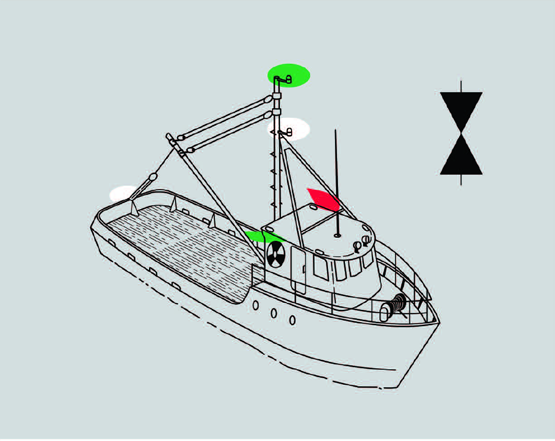
A vessel less than 50 meters in length, when engaged in trawling shall exhibit: two all-round lights in a vertical line, the upper being green and the lower white. If greater than 50 meters, a masthead light abaft of and higher than the all-round green light would also be needed.
Summary
A vessel engaged in fishing shows only the lights and shapes Rule 26 prescribes - nothing extra, nothing improvised. Trawling gets a green-over-white all-round light pair (or two apex-together cones by day), with a masthead light behind and above it once the vessel reaches 50 meters; fishing other than trawling gets red-over-white instead, plus an extra all-round white light or upward cone pointing toward any outlying gear reaching more than 150 meters from the boat. Either way, sidelights and a sternlight get added once the vessel is making way through the water. When several fishing vessels work close together, Annex II's additional signals apply on both international and inland waters. And the moment a vessel stops actually fishing, she has to drop the fishing lights and shapes and show only what a vessel of her length would normally carry - the fishing signals are not decorative, they are a claim about restricted maneuverability that has to be true.
Real World Example
The marker light or cone for outlying gear only shows you the far end of the line - the net or gear strung between the boat and that marker is usually invisible at night regardless, so staying clear of the marker light isn't the same as staying clear of the gear itself. Rule 26(e) also cuts the other way: a boat that leaves her fishing lights burning after she's actually stopped fishing is claiming a maneuverability excuse she no longer has, exactly the kind of detail that gets scrutinized after a collision.
Practice Questions
Q1. A trawler at night shows two all-round lights in a vertical line, the upper green and the lower white. What does Rule 26(b) tell you this vessel is doing, and what should you infer about her maneuverability?
A. She is engaged in trawling, and her gear may make sudden course changes or stops difficult.
B. She is anchored and fully maneuverable if needed.
C. She is a pilot vessel on duty.
D. She is not under command.
Q2. A fishing vessel other than a trawler has gear extending 200 meters horizontally from the boat. Under Rule 26(c)(ii), what additional light or shape must she show to mark that outlying gear?
A. Nothing extra is required regardless of how far the gear extends.
B. An all-round white light, or a cone apex upwards, in the direction of the gear.
C. A diamond shape at the bow.
D. Two red lights in a vertical line at the stern.