Rule 29
White over red - a boat with special duties
Official rule text as published in the U.S. Coast Guard Navigation Rules
Source: USCG NavCen / eCFR Navigation Rules · Last updated September 7, 2026
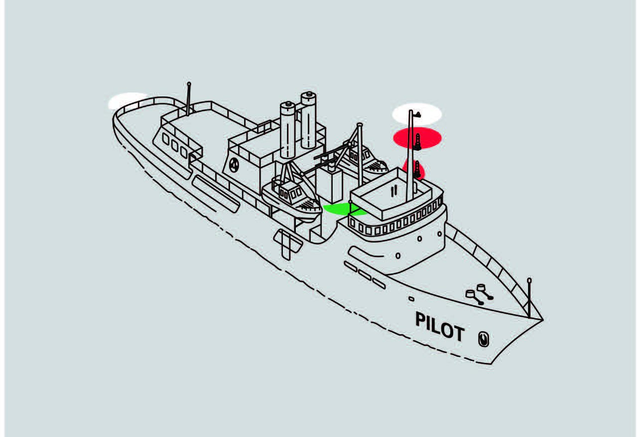
(a) A vessel engaged on pilotage duty shall exhibit: (i) at or near the masthead, two all-round lights in a vertical line, the upper being white and the lower red; (ii) when underway, in addition, sidelights and a sternlight; (iii) when at anchor, in addition to the lights prescribed in (a)(i), the light, lights, or shape prescribed in Rule 30 for vessels at anchor.
(b) A pilot vessel when not engaged on pilotage duty shall exhibit the lights or shapes prescribed for a similar vessel of her length.
MyCOLREGS explanation
Summary
A vessel engaged on pilotage duty carries two all-round lights in a vertical line near the masthead, white over red, plus sidelights and a sternlight while underway, and the normal anchor light or shape while anchored. Once she is not engaged in pilotage duty, she shows only the ordinary lights or shapes for a vessel of her size — no special pilot signal.
Real World Example
White-over-red near the masthead is your cue that this boat is about to do something no ordinary vessel would attempt: come in fast and close alongside a moving ship, sometimes in a shipping channel, to put a pilot aboard by ladder. Recognizing the signal early matters because a boat drifting in for a closer look at that maneuver is exactly the kind of small-craft mistake that turns a routine pilot transfer into a collision.
Practice Questions
Q1. A vessel underway on pilotage duty at night shows two all-round lights in a vertical line near the masthead. What are their colors, top to bottom?
A. White over green
B. Green over white
C. Red over white
D. White over red
Q2. A pilot boat has just dropped off her pilot and is no longer engaged on pilotage duty. What lights or shapes must she show?
A. The special pilot-vessel signal, regardless of duty status.
B. No lights at all until she resumes duty.
C. Three all-round red lights in a vertical line.
D. The ordinary lights or shapes prescribed for a vessel of her size.
Practice Question Answers
Q1.
D. White over red Rule 29(a)(i) prescribes white over red for a vessel engaged on pilotage duty. A, B, and C each get the color order or combination wrong - Rule 29's pilot signal is specifically white over red, top to bottom.
Q2.
D. The ordinary lights or shapes prescribed for a vessel of her size. Rule 29(b) says a pilot vessel not engaged on pilotage duty shows only the lights or shapes prescribed for a similar vessel of her length. A wrongly keeps the special pilot signal showing even when she's not on duty. B assumes no lights are needed at all, which isn't true for any underway vessel. C reaches for an unrelated signal that means something else entirely.