Rule 27(b)
Red-white-red means the work itself limits her
Official rule text as published in the U.S. Coast Guard Navigation Rules
Source: USCG NavCen / eCFR Navigation Rules · Last updated September 13, 2026
(b) A vessel restricted in her ability to maneuver, except a vessel engaged in mine clearance operations, shall exhibit: (i) three all-round lights in a vertical line where they can best be seen — the highest and lowest of these lights shall be red and the middle light shall be white; (ii) three shapes in a vertical line where they can best be seen — the highest and lowest of these shapes shall be balls and the middle one a diamond; (iii) when making way through the water, a masthead light(s), sidelights and a sternlight in addition to the lights prescribed in (b)(i); (iv) when at anchor, in addition to the lights or shapes prescribed in (b)(i) and (ii), the light, lights, or shapes prescribed in Rule 30.
MyCOLREGS explanation
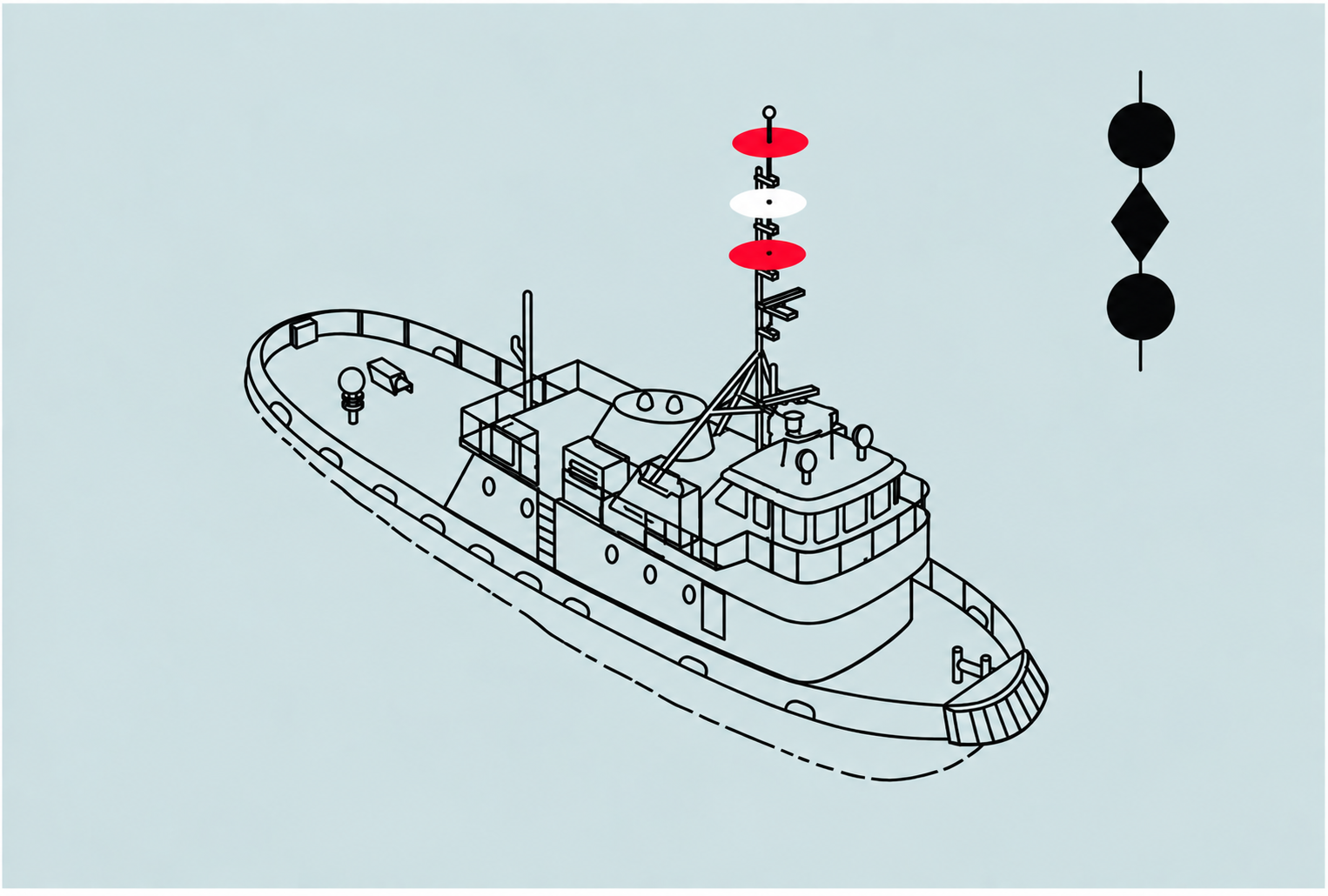
A vessel restricted in her ability to maneuver shall exhibit: three all-round lights in a vertical line, red-white-red (or three shapes, ball-diamond-ball, by day).
Summary
Restricted in ability to maneuver is a different situation from not under command: the vessel's own work - dredging, diving, mine clearance, towing an unwieldy load, and more - is what limits her, not a breakdown. She shows a three-light column, red over white over red, at night (or three shapes, ball-diamond-ball, by day). If she is making way through the water she adds a masthead light, sidelights, and a sternlight on top of that column, the same way any other underway vessel would.
Real World Example
A restricted-ability vessel's crew usually still has some control - they accepted the constraint to get a job done - but they cannot simply alter course the way an unencumbered vessel can. Give her room the same way you would a not-under-command vessel, but recognize the three-light red-white-red pattern as a different signal with a different cause.
Practice Questions
Q1. At night, a vessel making way shows a masthead light, sidelights, a sternlight, and - in addition - three all-round lights in a vertical line: red, white, red. Under Rule 27(b), what is she signaling?
A. She is not under command.
B. She is restricted in her ability to maneuver, and is currently making way through the water.
C. She is towing astern.
D. She is fishing.
Q2. By day, a vessel shows three shapes in a vertical line: a ball, a diamond, and a ball. Under Rule 27(b)(ii), what does this tell you?
A. She is not under command.
B. She is at anchor.
C. She is restricted in her ability to maneuver.
D. She is engaged in fishing.
Practice Question Answers
Q1.
B. She is restricted in her ability to maneuver, and is currently making way through the water. The red-white-red vertical column is the restricted-in-ability-to-maneuver signal; Rule 27(b)(iii) adds a masthead light, sidelights, and a sternlight to that column whenever the vessel is making way, distinguishing her from a not-under-command vessel (which shows two reds, not three lights). A's signal is two reds, not three lights. C and D each have their own distinct light patterns covered elsewhere.
Q2.
C. She is restricted in her ability to maneuver. Rule 27(b)(ii) prescribes a ball-diamond-ball vertical shape column as the daytime restricted-in-ability-to-maneuver signal, mirroring the red-white-red light column used at night. A's daytime signal is two balls, not a three-shape column. B and D each have their own distinct shapes.