Rule 28
A ship too deep to leave the channel
Official rule text as published in the U.S. Coast Guard Navigation Rules
Source: USCG NavCen / eCFR Navigation Rules · Last updated September 7, 2026
| International |
|---|
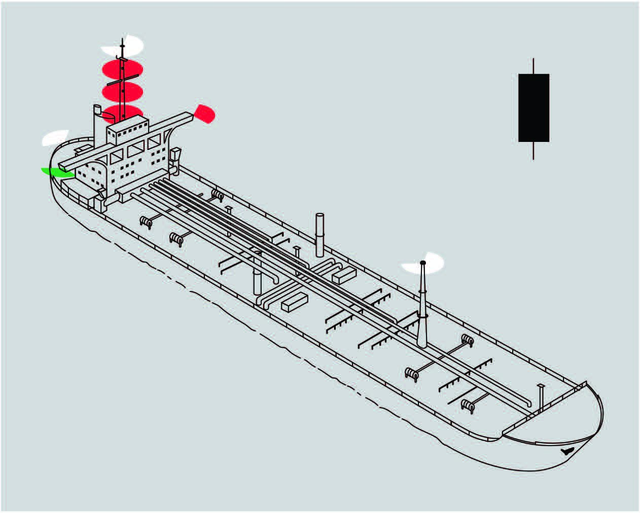
| A vessel constrained by her draft may, in addition to the lights prescribed for power-driven vessels in Rule 23(a), exhibit where they can best be seen three all-round red lights in a vertical line, or a cylinder. |
This designation and signal exist only in the International Rules. The corresponding position in the Inland Rules (33 CFR 83.28) is reserved — there is no Inland Rule 28 light or shape.
MyCOLREGS explanation
Summary
A vessel constrained by her draft is a deep-draft ship so limited by the depth of water beneath her that she cannot safely leave the channel she is in to avoid another vessel. Under the International Rules she may show three all-round red lights in a vertical line, or a cylinder shape by day, in addition to her normal power-driven lights — it is a discretionary signal, not mandatory. This entire designation is International-only: on U.S. inland waters there is no Rule 28 light or shape, even though the underlying hazard of a large ship confined to a channel is the same.
Real World Example
Because Rule 28's signal is discretionary even where it exists, a ship's captain may simply choose not to show it - so the absence of three red lights is never proof a deep-draft vessel isn't dangerously confined to her channel. What actually protects you is recognizing the situation itself: a loaded ship in a narrow, dredged approach has nowhere to go regardless of whether she bothers to light up and say so.
Practice Questions
Q1. A large tanker exhibits three all-round red lights in a vertical line in addition to her normal power-driven lights. What does this optional signal indicate, and where is it available?
A. She is constrained by her draft; the signal is available under the International Rules.
B. She is aground; the signal applies everywhere.
C. She is not under command; the signal applies on any waters.
D. She is restricted in her ability to maneuver; the signal is available under the Inland Rules.
Q2. You are operating on U.S. inland waters and encounter a deep-draft ship confined to a narrow channel by her draft. Which signal should you expect her to show under Rule 28?
A. Three all-round red lights in a vertical line, per Rule 28.
B. None — Rule 28 has no counterpart on inland waters; that position is reserved.
C. Alternating red and green flashing lights.
D. A single all-round white light.
Practice Question Answers
Q1.
A. She is constrained by her draft; the signal is available under the International Rules. Rule 28 lets a vessel constrained by her draft show three all-round red lights (or a cylinder) in addition to her ordinary power-driven lights, but this designation and signal exist only in the International Rules. B and C each name a different vessel status with its own distinct signal. D has the availability backwards - the constrained-by-draft signal is an International Rules option; inland waters have no counterpart, as the next question covers.
Q2.
B. None — Rule 28 has no counterpart on inland waters; that position is reserved. The Inland Rules reserve the Rule 28 position — there is no "constrained by draft" light signal on U.S. inland waters, even though the underlying hazard is the same. A applies the international signal to inland waters where it isn't available. C and D each invent a signal that Rule 28 doesn't describe - the actual answer is that inland waters have no counterpart provision at all.