Rule 27(a)
Two reds means she truly cannot maneuver
Official rule text as published in the U.S. Coast Guard Navigation Rules
Source: USCG NavCen / eCFR Navigation Rules · Last updated September 7, 2026
(a) A vessel not under command shall exhibit: (i) two all-round red lights in a vertical line where they can best be seen; (ii) two balls or similar shapes in a vertical line where they can best be seen; (iii) when making way through the water, in addition to the lights prescribed in this paragraph, sidelights and a sternlight.
MyCOLREGS explanation
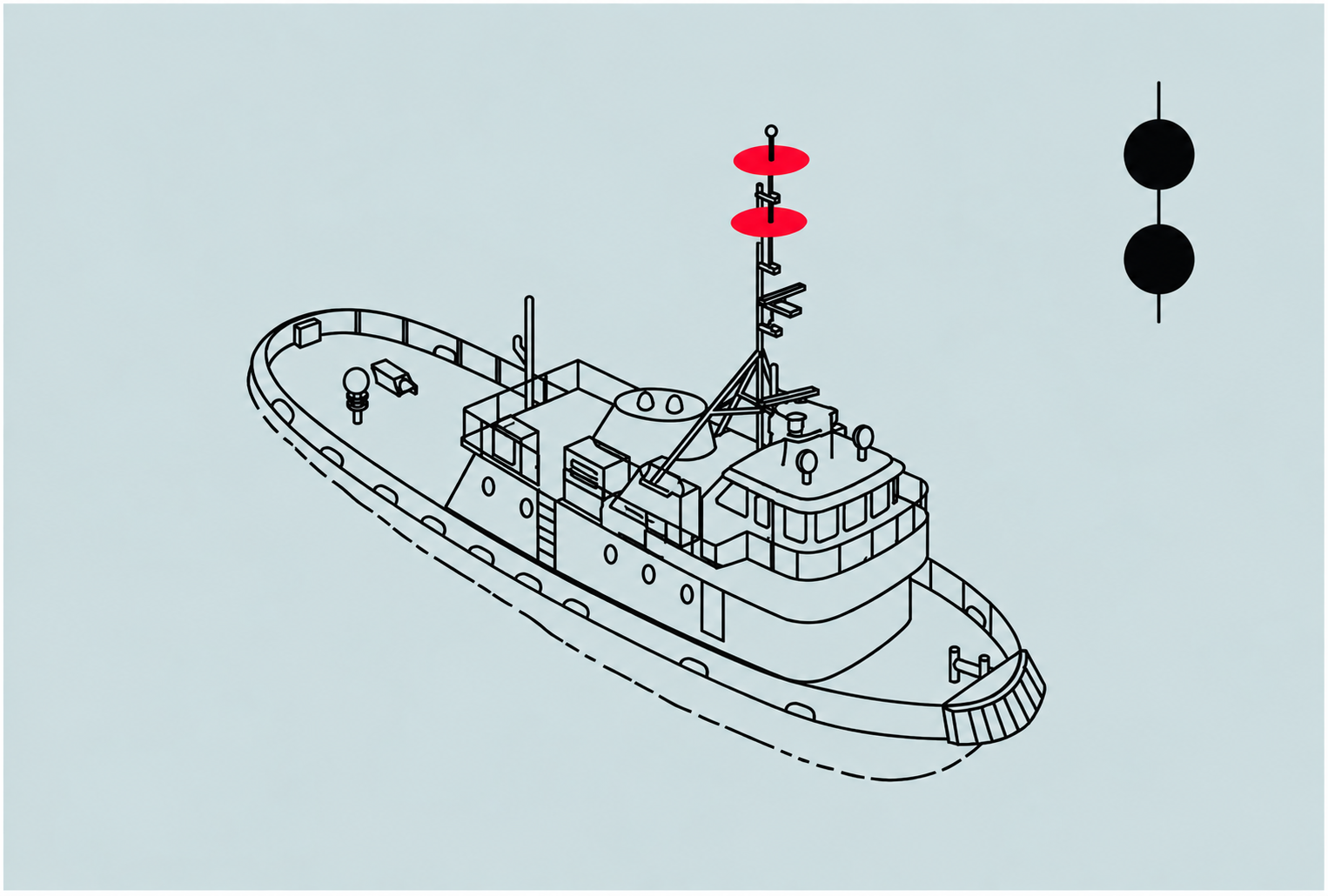
A vessel not under command shall exhibit: two all-round red lights in a vertical line (or two balls by day).
Summary
Not under command means something has genuinely broken - an engine failure, a steering casualty, some exceptional circumstance - and the vessel cannot maneuver as the Rules require, no matter how much her crew might want to. At night she shows two all-round red lights stacked vertically; by day, two black balls (or similar shapes) in the same vertical line. If she is still making way through the water - drifting or coasting, not under power control - she also shows sidelights and a sternlight alongside the two reds.
Real World Example
Two all-round reds, stacked, mean the vessel ahead cannot get out of your way even if she wanted to - there is no crew decision behind her position, only a mechanical or steering failure. Treat her exactly like a fixed obstruction with a very wide margin, not like a vessel you can expect to give way in a close-quarters situation.
Practice Questions
Q1. At night, another vessel shows two all-round red lights in a vertical line, nothing else. What is she signaling?
A. She is engaged in mine clearance.
B. She is restricted in her ability to maneuver.
C. She is not under command.
D. She is a pilot vessel on duty.
Q2. By day, that same vessel instead shows two black balls in a vertical line, and nothing else. Under Rule 27(a)(ii), what is she signaling?
A. She is restricted in her ability to maneuver.
B. She is not under command.
C. She is engaged in fishing.
D. She is at anchor.
Practice Question Answers
Q1.
C. She is not under command. Rule 27(a) prescribes two all-round red lights in a vertical line for a vessel not under command; a restricted-ability vessel shows a three-light red-white-red column instead. A reaches for an unrelated activity. B is the easy one to confuse this with - restricted in ability to maneuver uses a different, three-light red-white-red pattern, not two reds alone. D describes a different light pattern entirely (red over white).
Q2.
B. She is not under command. Rule 27(a)(ii) prescribes two balls (or similar shapes) in a vertical line as the daytime not-under-command signal - the shape equivalent of the two-red-lights signal used at night. A uses a three-shape ball-diamond-ball pattern, not two balls alone. C and D each have their own distinct shape signals covered elsewhere in the Rules.