Rule 27(d)
Which side is blocked, which side is clear
Official rule text as published in the U.S. Coast Guard Navigation Rules
Source: USCG NavCen / eCFR Navigation Rules · Last updated September 13, 2026
(d) A vessel engaged in dredging or underwater operations, when restricted in her ability to maneuver, shall exhibit the lights and shapes prescribed in (b)(i), (ii) and (iii) and shall in addition, when an obstruction exists, exhibit: (i) two all-round red lights or two balls in a vertical line to indicate the side on which the obstruction exists; (ii) two all-round green lights or two diamonds in a vertical line to indicate the side on which another vessel may pass; and (iii) when at anchor, the lights or shapes prescribed in this paragraph instead of the lights or shapes prescribed in Rule 30.
| Inland |
|---|
| (iv) Dredge pipelines that are floating or supported on trestles shall display the following lights at night and in periods of restricted visibility: (1) One row of yellow lights, flashing 50 to 70 times per minute, visible all round the horizon, visible for at least 2 miles, not less than 1 and not more than 3.5 meters above the water, approximately equally spaced, and not more than 10 meters apart where the pipeline crosses a navigable channel (where it does not cross a channel, the lights must be sufficient in number to clearly show the pipeline’s length and course). (2) Two red lights at each end of the pipeline, including the ends in a channel where the pipeline is separated to allow vessels to pass, visible all round the horizon and for at least 2 miles, one meter apart in a vertical line with the lower light at the same height above the water as the flashing yellow light. |
Color note: black text applies generally; blue is International Waters; green is Inland Waters.
MyCOLREGS explanation
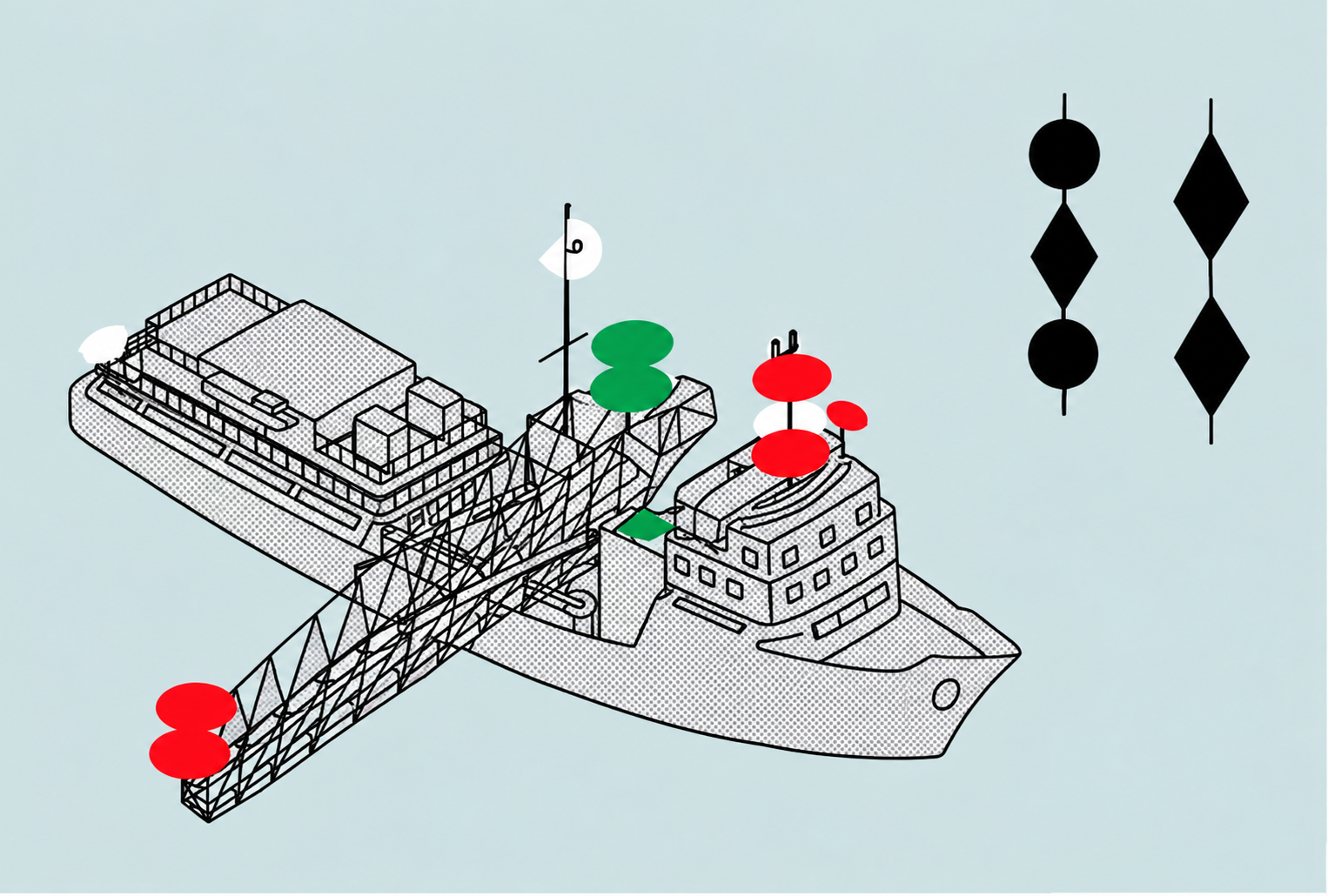
A vessel engaged in dredging, when an obstruction exists, shall exhibit two all-round red lights (or two balls) on the side of the obstruction, and two all-round green lights (or two diamonds) on the side another vessel may pass. The single additional green light shown here is her ordinary starboard sidelight - she is underway and making way through the water, so Rule 27(d)(iii)/(b)(iii) also requires her normal masthead light, sidelights, and sternlight alongside the restricted-ability and obstruction-side signals.
Summary
A dredge or underwater-operations vessel restricted in her ability to maneuver shows the same red-white-red column (or ball-diamond-ball shapes) as any other restricted vessel - but when her work actually blocks part of the channel, she adds a second signal: two reds (or two balls) stacked on the side where the obstruction sits, and two greens (or two diamonds) stacked on the side where it's safe to pass. At anchor, these obstruction-side signals replace the normal anchor lights entirely.
Real World Example
The red-side/green-side signal is the one piece of information you actually need to act on: it tells you which side of the dredge is blocked and which side is open, the same way a red or green channel marker would. Pass on the green side; treat the red side as a wall.
Practice Questions
Q1. A dredge working in a channel shows two all-round red lights on one side and two all-round green lights on the other, in addition to her restricted-ability lights. What do the red and green lights mean?
A. Red is for anchoring; green is for underway.
B. They indicate the dredge's registered nationality.
C. Red means stop; green means the channel is closed.
D. Red marks the obstructed side; green marks the side that is safe to pass.
Q2. A dredge restricted in her ability to maneuver is at anchor overnight, with an obstruction on one side. Under Rule 27(d)(iii), what does she show instead of ordinary anchor lights?
A. Nothing - a dredge at anchor is exempt from all lighting requirements.
B. The lights or shapes prescribed in Rule 27(d) itself (the restricted-ability column, plus red lights marking the obstructed side and green lights marking the side that's clear to pass), in place of Rule 30's anchor lights.
C. A single all-round white light, the same as any other vessel at anchor.
D. Two all-round red lights only, with no other signal.
Practice Question Answers
Q1.
D. Red marks the obstructed side; green marks the side that is safe to pass. Rule 27(d) requires a vessel restricted by dredging or underwater work to show two red lights (or balls) toward the obstruction and two green lights (or diamonds) toward the side safe to pass. A, B, and C each invent a meaning unrelated to what the colors actually signal - which side of the dredge is obstructed versus safe to pass, not activity status, nationality, or a stop instruction.
Q2.
B. The lights or shapes prescribed in Rule 27(d) itself (the restricted-ability column, plus red lights marking the obstructed side and green lights marking the side that's clear to pass), in place of Rule 30's anchor lights. Rule 27(d)(iii) specifically says that at anchor, the lights/shapes prescribed in Rule 27(d) replace the ordinary anchor lights/shapes - the dredge keeps showing her restricted-ability and obstruction-side signals instead of switching to a plain anchor light. A is wrong, C describes an ordinary anchored vessel's light (not this situation), D omits the restricted-ability column and green side-light.