Rule 27(f)
Three greens mean stay back 1000 meters
Official rule text as published in the U.S. Coast Guard Navigation Rules
Source: USCG NavCen / eCFR Navigation Rules · Last updated September 13, 2026
(f) A vessel engaged in mine clearance operations shall, in addition to the lights prescribed for a power-driven vessel in Rule 23(a) or to the lights or shape prescribed for a vessel at anchor in Rule 30 as appropriate, exhibit three all-round green lights or three balls, one near the foremast head and one at each end of the fore yard. These lights or shapes indicate that it is dangerous for another vessel to approach within 1000 meters of the mine clearance vessel.
MyCOLREGS explanation
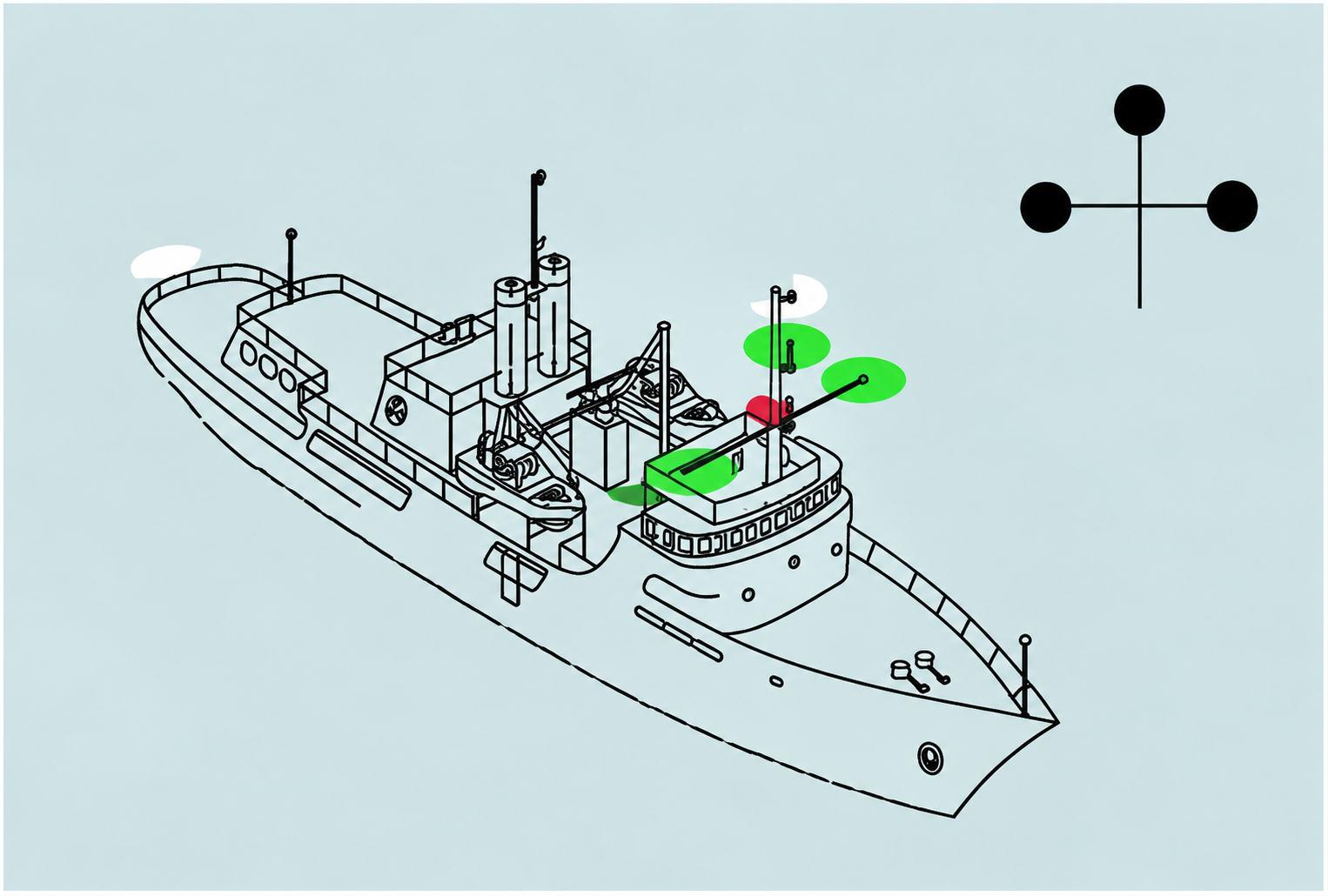
A vessel engaged in mine clearance operations shall exhibit three all-round green lights (or three balls by day), one near the foremast head and one at each end of the fore yard - approach within 1000 meters at your own risk. The single red light shown here is her ordinary port sidelight, not part of the mine-clearance signal itself (which is green-only) - she is underway, showing her normal Rule 23(a) power-driven lights alongside it.
Summary
A vessel engaged in mine clearance is deliberately excluded from the ordinary red-white-red restricted-ability signal - she gets her own, more urgent one. In addition to her normal power-driven (or at-anchor) lights, she shows three all-round green lights (or three balls by day), positioned near the foremast head and at each end of the fore yard. That specific pattern carries a built-in warning: stay at least 1000 meters clear.
Real World Example
The three-green pattern is one of the few COLREGS signals with an explicit, numeric keep-back distance attached to it - 1000 meters, not just 'give room.' Treat it as a hazard-area marker, not merely a maneuvering caution.
Practice Questions
Q1. At night, a power-driven vessel shows her normal Rule 23(a) lights, plus three additional all-round green lights positioned near the foremast head and each end of the fore yard. Under Rule 27(f), what is she signaling, and how close is it safe to approach?
A. She is restricted in her ability to maneuver in the ordinary sense; no specific distance is specified.
B. She is engaged in mine clearance operations; it is dangerous to approach within 1000 meters.
C. She is a fishing vessel with gear extending 150 meters; stay 150 meters clear.
D. She is towing; keep 200 meters clear of the tow.
Q2. Under Rule 27(f), where are the three all-round green lights (or three balls) of a mine clearance vessel positioned?
A. All three at the stern, in a vertical line.
B. One near the foremast head, and one at each end of the fore yard.
C. One at the bow, one amidships, one at the stern.
D. All three at the masthead, side by side.
Practice Question Answers
Q1.
B. She is engaged in mine clearance operations; it is dangerous to approach within 1000 meters. Rule 27(f) prescribes three all-round green lights (or three balls by day) specifically for mine clearance operations, with an explicit 1000-meter keep-clear distance - a notably larger margin than most other COLREGS signals specify. A describes the ordinary red-white-red signal, not this one. C and D each reference different rules with different distances.
Q2.
B. One near the foremast head, and one at each end of the fore yard. Rule 27(f) specifies this exact three-point placement - foremast head, and each end of the fore yard - distinct from the vertical-line placement used by every other Rule 27 signal. A, C, and D each describe placements not used by this Rule.