Rule 37
Distress signals mean immediate need
Official rule text as published in the U.S. Coast Guard Navigation Rules
Source: USCG NavCen / eCFR Navigation Rules · Last updated September 7, 2026
When a vessel is in distress and requires assistance, she shall use or exhibit the signals described in Annex IV to these Rules.
Annex IV — Distress Signals (33 CFR 87)
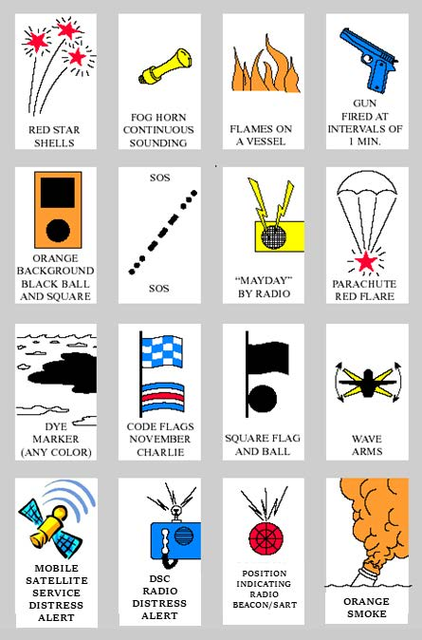
1. Need of assistance. The following signals, used or exhibited either together or separately, indicate distress and need of assistance: (a) a gun or other explosive signal fired at intervals of about a minute; (b) a continuous sounding with any fog-signaling apparatus; (c) rockets or shells, throwing red stars fired one at a time at short intervals; (d) a signal made by any signaling method consisting of the group …———… (SOS) in the Morse Code; (e) a signal sent by radiotelephony consisting of the spoken word “Mayday”; (f) the International Code Signal of distress indicated by N.C.; (g) a signal consisting of a square flag having above or below it a ball or anything resembling a ball; (h) flames on the vessel (as from a burning tar barrel, oil barrel, etc.); (i) a rocket parachute flare or a hand flare showing a red light; (j) a smoke signal giving off orange-colored smoke; (k) slowly and repeatedly raising and lowering arms outstretched to each side; (l) a distress alert by means of digital selective calling (DSC) transmitted on VHF channel 70, or MF/HF on the frequencies 2187.5 kHz, 8414.5 kHz, 4207.5 kHz, 6312 kHz, 12577 kHz or 16804.5 kHz; (m) a ship-to-shore distress alert transmitted by the ship’s Inmarsat or other mobile satellite service provider ship earth station; (n) signals transmitted by emergency position-indicating radio beacons (EPIRBs); (o) approved signals transmitted by radiocommunication systems, including survival craft radar transponders; (p) a high intensity white light flashing at regular intervals from 50 to 70 times per minute.
2. Exclusive use. The use or exhibition of any of the foregoing signals except for the purpose of indicating distress and need of assistance, and the use of other signals which may be confused with any of the above signals, is prohibited.
3. Supplemental signals. Attention is drawn to the relevant sections of the International Code of Signals, the International Aeronautical and Maritime Search and Rescue Manual, Volume III, [the International Telecommunication Union Radio Regulations,] and the following signals: (a) a piece of orange-colored canvas with either a black square and circle or other appropriate symbol (for identification from the air); (b) a dye marker.
Color note: black text applies generally; blue is International Waters; green is Inland Waters.
MyCOLREGS explanation
Summary
Rule 37 itself just says: if you are in distress and need help, use the signals in Annex IV. Annex IV then lists them out — flares and rockets showing red stars, continuous fog-horn sounding, SOS in Morse code, the spoken word “Mayday,” a square flag with a ball above or below it, orange smoke, slowly raising and lowering outstretched arms, a DSC distress alert, an EPIRB, and more. None of these signals may be used for anything except an actual distress call, and nothing that could be confused with one of them should be used for any other purpose.
Real World Example
Firing a flare or broadcasting Mayday when you're not actually in distress isn't a harmless way to get noticed - it can trigger a real search-and-rescue launch, and Annex IV makes non-distress use of these signals a violation in its own right, precisely so a genuine flare is never the boy who cried wolf.
Practice Questions
Q1. Which of the following is listed in Annex IV as a distress signal referenced by Rule 37?
A. Two all-round red lights in a vertical line.
B. Three short blasts on the whistle.
C. A single prolonged blast every 2 minutes.
D. A signal consisting of SOS in Morse code, by any signaling method.
Q2. You see a person on another vessel slowly and repeatedly raising and lowering her outstretched arms. Under Annex IV, what should you understand this to mean, and what restriction applies to using this signal?
A. It is a greeting with no navigational significance, similar to a friendly wave exchanged between passing vessels on the water.
B. It is a recognized distress signal, and it must not be used or exhibited except to indicate actual distress and need of assistance.
C. It has no defined meaning under the Rules, so it may be interpreted however each vessel's crew chooses in the moment.
D. It means the vessel wants you to overtake on her port side, a maneuvering signal rather than anything related to distress.
Practice Question Answers
Q1.
D. A signal consisting of SOS in Morse code, by any signaling method. Annex IV, referenced by Rule 37, lists SOS in Morse code (by any means) among the recognized distress signals, alongside flares, Mayday calls, and others. A, B, and C each name a real signal from elsewhere in the Rules, but none of them is a distress signal - SOS in Morse, by any method, is what Annex IV lists.
Q2.
B. It is a recognized distress signal, and it must not be used or exhibited except to indicate actual distress and need of assistance. Annex IV lists this gesture as a distress signal, and Annex IV section 2 prohibits using any of the listed signals for any purpose other than indicating actual distress. A dismisses it as meaningless. C denies it has a defined meaning, when Annex IV specifically lists it. D invents an unrelated navigational meaning - the real answer is that it's a genuine distress signal, reserved strictly for actual emergencies.