Browse the COLREGS Manual

View:
Home Progress Manage The Manual Guides
Rule 30
Anchor lights do not mean moving traffic
Official rule text as published in the U.S. Coast Guard Navigation Rules
Source: USCG NavCen / eCFR Navigation Rules · Last updated September 7, 2026

(a) A vessel at anchor shall exhibit where it can best be seen: (i) in the fore part, an all-round white light or one ball; (ii) at or near the stern and at a lower level than the light prescribed in (a)(i), an all-round white light.

(b) A vessel of less than 50 meters in length may exhibit an all-round white light where it can best be seen instead of the lights prescribed in (a).

(c) A vessel at anchor may, and a vessel of 100 meters and more in length shall, also use the available working or equivalent lights to illuminate her decks.

(d) A vessel aground shall exhibit the lights prescribed in (a) or (b) and, in addition, if practicable, where they can best be seen: (i) two all-round red lights in a vertical line; (ii) three balls in a vertical line.

(e) A vessel of less than 7 meters in length, when at anchor not in or near a narrow channel, fairway or where other vessels normally navigate, shall not be required to exhibit the lights or shape prescribed in (a) and (b).

(f) A vessel of less than 12 meters in length, when aground, shall not be required to exhibit the lights or shapes prescribed in (d)(i) and (ii).

Inland
(g) A vessel of less than 20 meters in length, when at anchor in a special anchorage area designated by the Coast Guard, shall not be required to exhibit the anchor lights and shapes required by this Rule.
(h) The following barges shall display at night, and if practicable in periods of restricted visibility, the lights described in (i): (i) every barge projecting into a buoyed or restricted channel; (ii) every barge so moored that it reduces the available navigable width of any channel to less than 80 meters; (iii) barges moored in groups more than two barges wide or to a maximum width of over 25 meters; (iv) every barge not moored parallel to the bank or dock.
(i) Barges described in (h) shall carry two unobstructed all-round white lights of an intensity to be visible for at least 1 nautical mile, meeting the technical requirements of Annex I.
(j) A barge or group of barges at anchor or made fast to one or more mooring buoys or similar device, in lieu of the provisions of this Rule, may carry unobstructed all-round white lights of the same intensity, arranged as follows: (i) a barge projecting from a group formation shall be lighted on its outboard corners; (ii) a single barge moored where other vessels normally navigate on both sides shall have lights marking its corner extremities; (iii) barges moored in group formation, where other vessels normally navigate on both sides of the group, shall have lights marking the corner extremities of the group.
(k) The following are exempt from the requirements of this Rule: (i) a barge or group of barges moored in a slip or slough used primarily for mooring purposes; (ii) a barge or group of barges moored behind a pierhead; (iii) a barge less than 20 meters in length when moored in a Coast Guard-designated special anchorage area.
(l) Barges moored in well-illuminated areas are exempt from the lighting requirements of this Rule. These well-illuminated areas are specific, individually designated mile-marker segments along the Chicago Sanitary Ship Canal, Calumet Sag Channel, Little Calumet River, Calumet River, and Cumberland River, as listed by mile marker in 33 CFR 90.
MyCOLREGS explanation
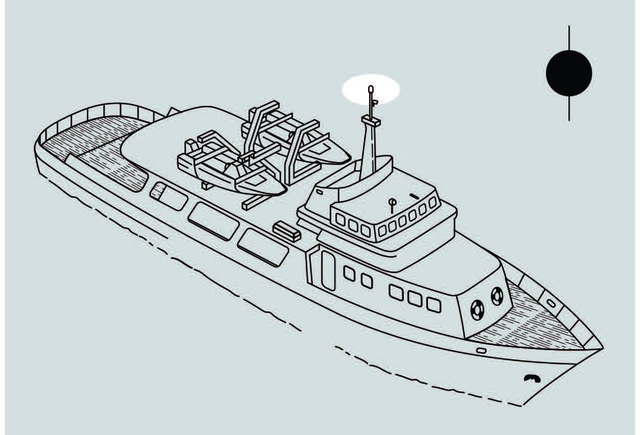
Training diagram for Anchor lights do not mean moving traffic
A vessel of less than 50 meters in length may exhibit an all-round white light where it can best be seen. If more than 50 meters in the fore part, an additional all-round white light or one ball
Summary
A vessel at anchor shows a white light in the fore part and a lower white light near the stern (or just one all-round white light if she is under 50 meters). A vessel aground shows those same anchor lights plus two all-round red lights in a vertical line, or three balls, so other traffic knows she is stuck, not just anchored. Small craft get relief: under 7 meters, anchored away from channels, needs no anchor light at all; under 12 meters, aground, needs no red lights or balls. On U.S. inland waters there are added rules for anchored barges, including corner-marking lights for barges in busy channels, plus exemptions for small vessels anchored in Coast Guard-designated special anchorage areas.
Real World Example
An anchor light says a boat chose to stop there; the added two red lights for a vessel aground say the water chose for her, and whatever put her there - a shoal, a rock, a falling tide - is very likely still under your own hull if you close the distance without a wide margin. That's a different kind of caution than routine anchorage courtesy, which is why Rule 30 treats it as a distinct signal instead of folding it into ordinary anchor lights.

Practice Questions

Q1. You see a vessel at night showing her normal anchor lights plus two all-round red lights in a vertical line. What should you conclude?
A. She is aground, not just anchored.
B. She is not under command.
C. She is restricted in her ability to maneuver.
D. She is a pilot vessel.
Q2. A 6-meter runabout anchors overnight well clear of any channel or area where other vessels normally navigate. Is she required to show an anchor light?
A. No, anchor lights are never required on inland waters.
B. No — vessels under 7 meters anchored away from channels/fairways are exempt under Rule 30(e).
C. Yes, always, regardless of size or location.
D. Only if she is aground.

Practice Question Answers

Q1.
A. She is aground, not just anchored. Rule 30(d) requires a vessel aground to show her anchor lights plus two all-round red lights in a vertical line (or three balls by day), distinguishing "aground" from simply "at anchor." B, C, and D each reach for a different vessel status with its own separate signal - not-under-command, restricted ability, or pilot duty - none of which combines with anchor lights the way the aground signal does.
Q2.
B. No — vessels under 7 meters anchored away from channels/fairways are exempt under Rule 30(e). Rule 30(e) exempts vessels under 7 meters in length from the anchor light/shape requirement when anchored away from a narrow channel, fairway, or area where other vessels normally navigate. A overstates the exemption as covering all inland anchoring, when it's specifically for small vessels away from channels. C denies any exemption exists, contradicting Rule 30(e) directly. D attaches the requirement to being aground, which is a different situation altogether.