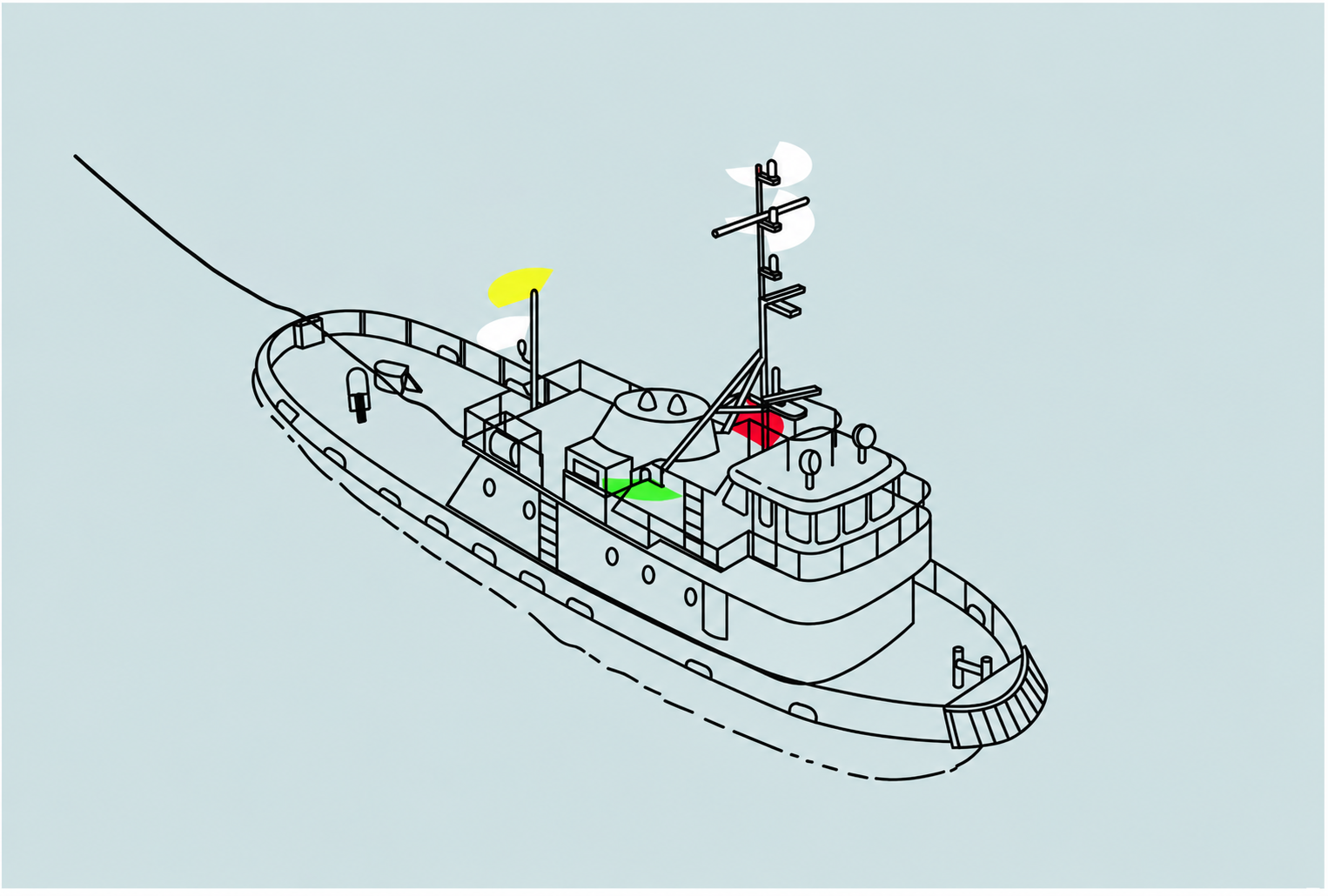
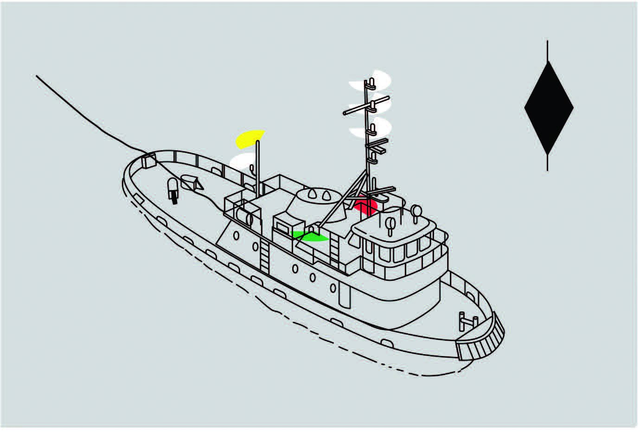
(a) A power-driven vessel when towing astern shall exhibit: (i) Instead of the light prescribed in Rule 23(a)(i) or Rule 23(a)(ii), two masthead lights in a vertical line. When the length of the tow, measuring from the stern of the towing vessel to the after end of the tow, exceeds 200 meters, three such lights in a vertical line; (ii) sidelights; (iii) a sternlight; (iv) a towing light in a vertical line above the sternlight; and (v) when the length of the tow exceeds 200 meters, a diamond shape where it can best be seen.
(b) When a pushing vessel and a vessel being pushed ahead are rigidly connected in a composite unit they shall be regarded as a power-driven vessel and exhibit the lights prescribed in Rule 23(a).
(c) A power-driven vessel when pushing ahead or towing alongside, except in the case of a composite unit as required by Rule 24(b) and (g)(i), shall exhibit: (i) instead of the light prescribed in Rule 23(a)(i) or Rule 23(a)(ii), two masthead lights in a vertical line; (ii) sidelights; and (iii) a sternlight two towing lights in a vertical line.
(d) A power-driven vessel to which Rule 24(a) or (c) applies shall also comply with Rule 23(a) (a)(i) and (a)(ii).
(e) A vessel or object being towed, other than those referred to in Rule 24(g), shall exhibit: (i) sidelights; (ii) a sternlight; and (iii) when the length of the tow exceeds 200 meters, a diamond shape where it can best be seen.
(f) Provided that any number of vessels being towed alongside or pushed in a group shall be lighted as one vessel except as provided in Rule 24(f)(iii): (i) a vessel being pushed ahead, not being part of a composite unit, shall exhibit at the forward end, sidelights, and a special flashing light; (ii) a vessel being towed alongside shall exhibit a sternlight and at the forward end, sidelights, and a special flashing light.
| Inland |
|---|
| (iii) when vessels are towed alongside on both sides of the towing vessel a sternlight shall be exhibited on the stern of the outboard vessel on each side of the towing vessel, and a single set of sidelights as far forward and as far outboard as is practicable, and a single special flashing light. |
(g) An inconspicuous, partly submerged vessel or object, or combination of such vessels or objects being towed, shall exhibit:
| International | Inland |
|---|---|
| (i) if it is less than 25 meters in breadth, one all-round white light at or near the forward end and one at or near the after end, except that dracones need not exhibit a light at or near the forward end; (ii) if it is 25 meters or more in breadth, two additional all-round white lights at or near the extremities of its breadth; | (i) if it is less than 25 meters in breadth, one all-round white light at or near the forward end and one at or near the after end, except that dracones need not exhibit a light at or near each end; (ii) if it is 25 meters or more in breadth, four all-round white lights to mark its length and breadth; |
(iii) if it exceeds 100 meters in length, additional all-round white lights between the lights prescribed in Rule 24(g)(i) and (ii) and so that the distance between the lights shall not exceed 100 meters, provided that any vessels or objects being towed alongside each other shall be lighted as one vessel or object; (iv) a diamond shape at or near the aftermost extremity of the last vessel or object being towed; and if the length of the tow exceeds 200 meters an additional diamond shape where it can best be seen and located as far forward as is practicable.
| Inland |
|---|
| (v) the towing vessel may direct a searchlight in the direction of the tow to indicate its presence to an approaching vessel. |
(h) Where from any sufficient cause it is impracticable for a vessel or object being towed to exhibit the lights or shapes prescribed in Rule 24(e) or (g), all possible measures shall be taken to light such the unlighted vessel or object.
(i) Where from any sufficient cause it is impracticable for a vessel not normally engaged in towing operations to display the lights prescribed in Rule 24(a) or Rule 24(c), such vessel shall not be required to exhibit those lights when engaged in towing another vessel in distress or otherwise in need of assistance. All possible measures shall be taken to indicate the nature of the relationship between the towing vessel and the vessel being towed as authorized by Rule 36, in particular by illuminating the towline and the vessel being assisted. The searchlight authorized by Rule 36 may be used to illuminate the tow.
| Inland |
|---|
| (j) Notwithstanding Rule 24(c), on the Western Rivers (except below the Huey P. Long Bridge on the Mississippi River) and on waters specified by the Secretary, a power-driven vessel when pushing ahead or towing alongside, except as Rule 24(b) applies, shall exhibit: (i) sidelights; and (ii) two towing lights in a vertical line. |
Color note: black text applies generally; blue is International Waters; green is Inland Waters.