Rule 27(c)
A tow so unwieldy it counts as restricted, too
Official rule text as published in the U.S. Coast Guard Navigation Rules
Source: USCG NavCen / eCFR Navigation Rules · Last updated September 13, 2026
(c) A power-driven vessel engaged in a towing operation such as severely restricts the towing vessel and her tow in their ability to deviate from their course shall, in addition to the lights or shape prescribed in Rule 24(a), exhibit the lights or shapes prescribed in subparagraphs (b)(i) and (ii) of this Rule.
MyCOLREGS explanation
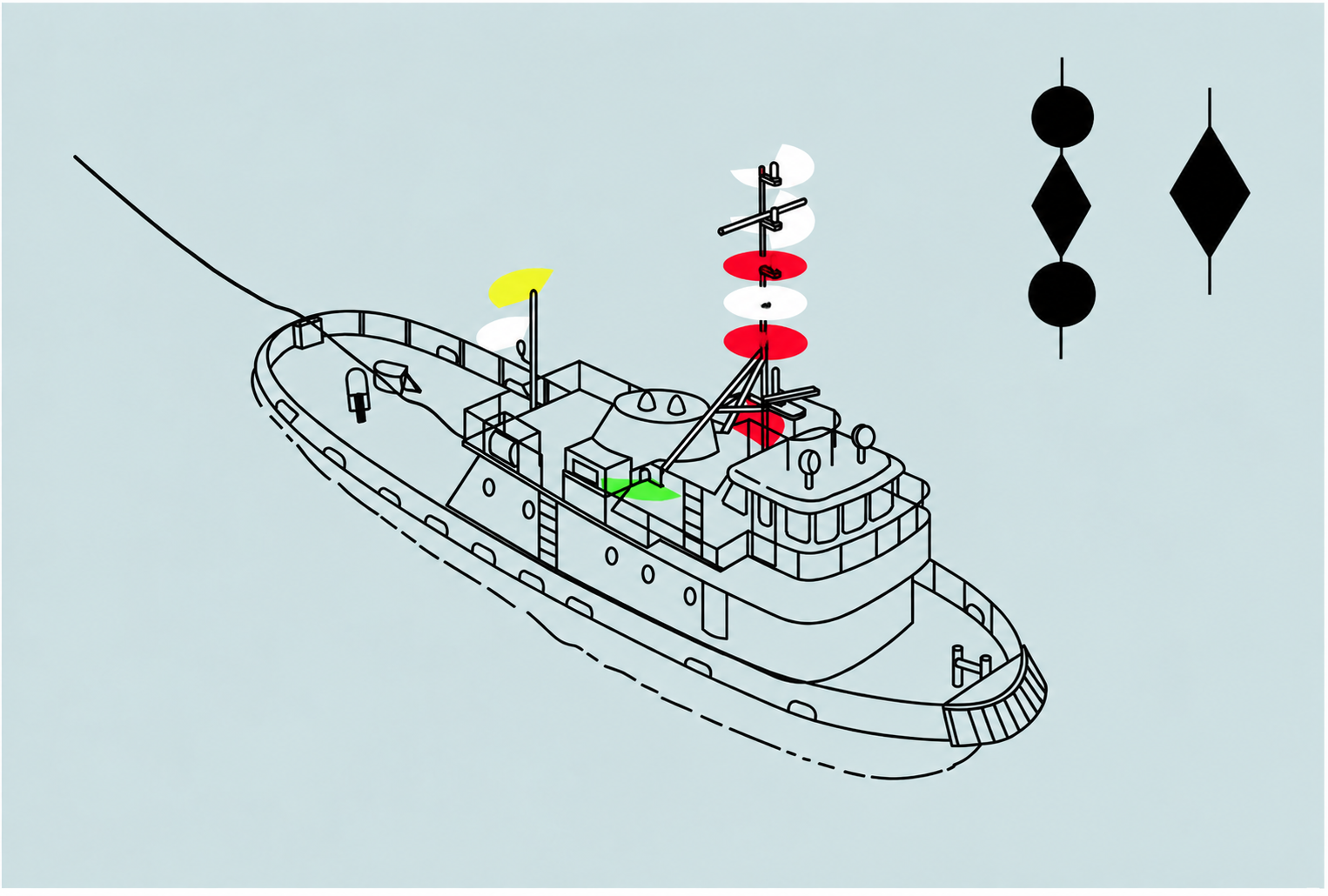
A power-driven vessel engaged in a towing operation that severely restricts her and her tow's ability to deviate from course shall exhibit the Rule 24(a) towing lights, plus the red-white-red restricted-ability column (or ball-diamond-ball shapes).
Summary
An ordinary tow shows Rule 24(a)'s lights - two masthead lights in a vertical line, sidelights, a sternlight, and a towing light. But when the tow itself is so large or unwieldy that the towing vessel and her tow genuinely cannot deviate from their course, Rule 27(c) adds the restricted-in-ability-to-maneuver signal on top: the red-white-red light column at night, or the ball-diamond-ball shapes by day, right alongside the normal towing lights.
Real World Example
Two vessels showing ordinary towing lights plus a red-white-red column are telling you something extra: this particular tow cannot simply steer around you the way a normal tug-and-barge combination might. Give the whole combination - tug, towline, and tow - even more room than an ordinary tow would require.
Practice Questions
Q1. A tug towing astern shows the usual Rule 24(a) towing lights - plus, in addition, a red-white-red vertical light column. Under Rule 27(c), what does the extra column tell you?
A. Nothing extra - it's just a backup set of towing lights in case one fails.
B. This particular tow is so large or unwieldy that the tug and her tow cannot readily deviate from their course.
C. The tug is not under command and has lost her tow.
D. The tug is now anchored.
Q2. Under Rule 27(c), when a towing operation severely restricts the tug and her tow's ability to deviate from course, which lights/shapes get added to the ordinary Rule 24(a) towing signal?
A. An all-round white light at the stern of the tow.
B. A diamond shape only, with no accompanying lights.
C. Two all-round green lights in a vertical line.
D. The lights or shapes prescribed in Rule 27(b)(i) and (ii) - the red-white-red column, or ball-diamond-ball shapes.
Practice Question Answers
Q1.
B. This particular tow is so large or unwieldy that the tug and her tow cannot readily deviate from their course. Rule 27(c) adds the restricted-in-ability-to-maneuver lights/shapes (from Rule 27(b)(i) and (ii)) on top of the ordinary Rule 24(a) towing lights specifically when the towing operation severely restricts the tug and tow's ability to change course. A treats a meaningful extra signal as redundant. C and D each have their own separate, different light patterns.
Q2.
D. The lights or shapes prescribed in Rule 27(b)(i) and (ii) - the red-white-red column, or ball-diamond-ball shapes. Rule 27(c) specifically cross-references Rule 27(b)(i) and (ii) - the same red-white-red light column and ball-diamond-ball shapes used by any other restricted-in-ability-to-maneuver vessel. A, B, and C each describe signals used elsewhere in the Rules, not this one.